
Search Oakland County Property Records
The easiest way in is usually a street address. The parcel identifier is still the better handoff key. Look up the situs address, meaning the physical location, in the municipal assessor's system or the Oakland County Property Gateway. Copy the parcel number exactly. Grab the county KeyPIN too. These identifiers keep similar street names, mailing addresses, condominiums, and same-name owners from blurring together.
The Oakland County Super Index then opens the deed side of the file. Mortgages, releases, liens, and plats appear there too. The assessment roll supplies the owner label, property class, and value fields, while treasurer systems answer current or delinquent tax questions and GIS places the parcel among roads and neighboring lots. Remember that a public index is evidence, not a title opinion, and GIS lines are reference lines, not a legal survey.
- Search the city or township assessment portal by street address.
- Save the PIN, KeyPIN, situs, owner label, and assessment jurisdiction.
- Match the latest deed in the Super Index by parcel, party, and legal description.
- Check the Treasurer source for the separate tax balance and payment history.
- Use GIS, plats, the records counter, or a written request when online data is thin.
Who Keeps Oakland Property Records
Oakland County property records are split by function. The Clerk/Register of Deeds records instruments and maintains the Super Index and Tract Index. The local assessor prepares the live assessment roll. Oakland County Equalization then reviews and equalizes those rolls. The Treasurer handles delinquent county tax accounts, while current collection starts with the local treasurer. This split matters because deeds, owner labels, and tax balances update on different schedules.
Oakland County Recorder / Register of Deeds
1200 N Telegraph Road
Pontiac, MI 48341
248-858-0581
Oakland County Equalization
250 Elizabeth Lake Road, Suite 1000W
Pontiac, MI 48341
248-858-0740
Oakland County Treasurer / Tax Collector
1200 N Telegraph Road
Pontiac, MI 48341
248-858-0611
Oakland Super Index Search
The Oakland County Super Index offers simple and advanced search paths. A party search splits into two roles. The grantor gives an interest. The grantee receives it. Advanced fields narrow results by document type, recording date, liber and page, reception or document number, parcel number, and address. A broad owner name can pull in unrelated people or entities, so a PIN plus a date range makes a strong filter.
Searching the index is free. Guest access to document details and downloaded images can carry a charge, and an online image is not a certified copy. Freshly recorded documents may appear before every party name or legal description finishes indexing. Search both names and the parcel. Check again if a new closing is missing.
The county deed-index source displays the party, document, and parcel fields directly, so open the official search page and review each option before a query begins.
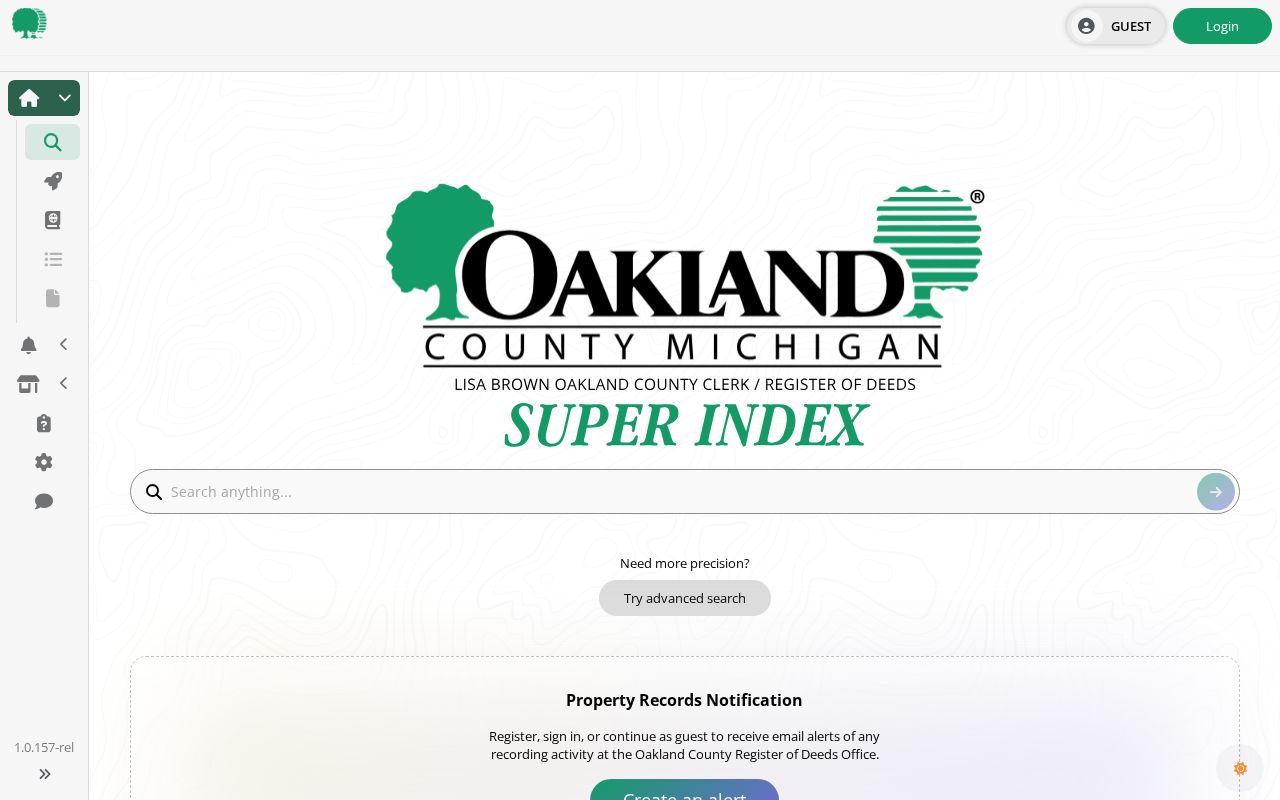
The screen works best once the parcel and likely party names are already known. Note the search date with each result.
Parcel Numbers Bridge Oakland Records
One parcel in Oakland County can carry several labels. The street address is the situs. A municipal portal may show a Sidwell-style parcel number, while county GIS relies on the KeyPIN as its linking identifier. A recorded deed may lead with something else entirely. Metes and bounds, a subdivision lot and block, a condominium unit, or a liber and page reference can all head the document, so keep each label rather than forcing them into one invented number.
Useful record terms
- Parcel
- A mapped tax unit, which may not match a surveyed ownership boundary in every detail.
- KeyPIN
- The county GIS key used to join parcel geometry and attributes.
- Plat
- A recorded map creating lots, blocks, streets, and other interests.
- Situs
- The physical property address, distinct from the owner's mailing address.
Address spelling can sink an otherwise valid search. Try the house number without a suffix, a shortened street name, the legal description, or old subdivision terms. Property Gateway accepts a percent sign as a wildcard. It also takes multiple comma-separated PINs, a handy quirk when several related parcels are in play.
Oakland Property Record Types
Each Oakland record set answers a different question. The deed index documents recorded transfers and claims. Assessment records describe the parcel for tax administration, treasurer records show billed or delinquent amounts, and plats and GIS explain location. Building departments preserve permit and inspection history. Comparing these sources beats treating one screen as the complete property file.
| Record Type | What It Documents | Kept By | Access |
|---|---|---|---|
| Deeds | Recorded transfers, parties, legal descriptions | Clerk/Register of Deeds | Free index; paid images or copies |
| Mortgages and liens | Recorded claims, assignments, releases | Clerk/Register of Deeds | Super Index and records counter |
| Assessment | Owner label, class, AV, SEV, TV, characteristics | City or township assessor | Municipal portal or assessor |
| Taxes | Bill, payment, delinquency, special charges | Local and county treasurers | PayIt, Property Gateway, office |
| Plats and parcels | Lot identity, map position, subdivision context | Register of Deeds and GIS | Index, map services, counter |
| Building permits | Applied work, issued permits, inspections | City or township | Local portal and records request |
A buyer verifying recorded ownership starts with the deed and legal description. Value questions belong to the roll. Amount-due questions belong to the treasurer. The separate Oakland County deed records page explains recorded proof, and the tax page covers assessment and collection without blending the two.
Three Oakland Assessment Values
Michigan assessment records use several distinct values. True cash value is the assessor's market estimate. Assessed value generally sits at 50 percent of that figure, and State Equalized Value reflects equalization. Taxable value is the tax base under Proposal A. It can stay capped until the parcel transfers. A recent sale may uncap taxable value for the following year, though the deed's consideration does not automatically become the assessor's true cash value.
| Field | Meaning | Best source |
|---|---|---|
| AV | Initial assessed value, generally half of true cash value | Assessment card and notice |
| SEV | Value after county and state equalization | Assessment roll |
| TV | Proposal A tax base used with millage | Assessment roll and notice |
| Sale price | Separate transaction evidence | Sale table and recorded instrument |
The Notice of Assessment also lists classification, exemption percentage, and whether a transfer occurred. It is not a tax bill. Current bills come from the local treasurer.
Oakland GIS Shows Parcel Context
Oakland County maps its parcels through Oakland Enterprise GIS. It publishes parcel polygons and attributes as map services and open data. The Tax Parcel 2024 feature service answers both field and geographic queries. Its KeyPIN links map shapes to parcel data. Roads, sections, aerial imagery, and local zoning layers help you pin down the right lot. One caution applies. The service caps results at 2,000 records. A broad download cannot replace a targeted parcel search. Open the official Oakland parcel service to browse its layers and current metadata.
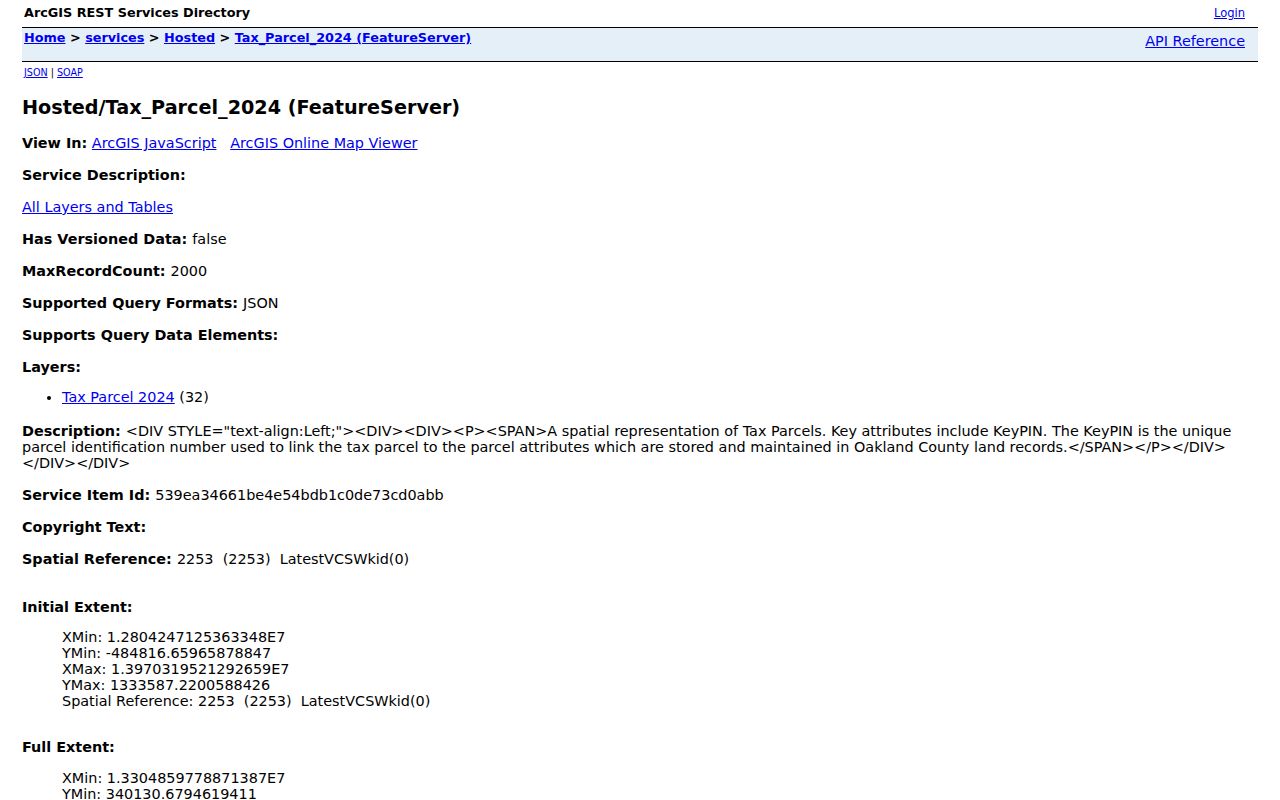
The service shows the county's data structure as it exists. For anything turning on exact legal boundaries, a licensed survey and the recorded plat still control the answer.
Oakland Taxes Use Two Channels
Start current taxes with the city or township treasurer. Each municipality runs its own tax system. Oakland County also offers PayIt for county tax searches and payments. Property Gateway sells a paid official delinquent statement. That statement may bundle base tax, interest, fees, special assessments, and other charges. It is not proof of ownership. Tax distress unfolds in stages. Delinquency, forfeiture, foreclosure, sale, and a possible surplus claim are distinct events. Note the tax-year status and retrieval date with any result. If a foreclosure changed title, confirm the instrument in the Super Index. Do not infer a transfer from a balance screen.
Oakland Permits Stay Local
Building and zoning records usually live with the city or township. Troy runs an issued-permit search plus a municipal Parcel Information Center. Farmington Hills shifted permits and inspections to BS&A in early March 2026. Rochester Hills also uses BS&A and posts zoning layers through its Atlas GIS. Local files like these can reveal work history, inspections, zoning, or planning context. No deed will show that. A permit does not prove work was finished. A missing web result does not prove no permit exists. For older registers, plans, inspection records, or nonexempt correspondence, ask the building or planning office. A written Michigan FOIA request should name the address, parcel number, record type, and date range.
Oakland Deeds Before 1964
Oakland County's computerized tract and deed database starts in January 1964. Older ownership needs a bridge. Researchers work from the newest known deed back through older indexes. They also rely on liber and page references, plats, and historic books. FamilySearch catalogs Oakland deed books from 1801 through 1900. Wait, the catalog runs to 1901. FamilySearch catalogs Oakland deed books from 1801 through 1901. It also holds general indexes from 1799 through 1920. The Archives of Michigan and Library of Michigan add tax sources. Those collections also cover probate, court, directory, and map records. Historic jurisdiction can differ from today's map, since Oakland once covered land later assigned elsewhere. Archives staff may ask for township, range, and section rather than a modern address. Local historical and genealogical collections can suggest an old street, subdivision, or resident name. Before any ownership claim, those clues must return to the recorded deed and legal description.
Property Fraud Alerts by PIN
Oakland County offers free Property Records Notification once an owner verifies the recorded deed. Subscribe with the precise ten-digit PIN. That cuts unrelated alerts triggered by common names. An alert reports indexing activity matching your chosen terms, nothing more. It cannot stop a filing, judge an instrument's validity, or replace periodic title review. Newly recorded documents can appear before all names and legal descriptions are entered. So a PIN alert is useful but not final. When one arrives, compare its document number, parties, date, and legal description with the parcel. Contact the Register of Deeds if the filing is unfamiliar.
Oakland Property Record Fallbacks
Online systems run on different clocks and coverage. A guest image is not always available. The Register of Deeds counter, telephone, and mail copy channels still support deed and tract research. Older court matters can be requested from the Legal Records Department. Local assessors and treasurers hold parcel cards or ledgers. Libraries and archives keep older volumes and contextual collections. Michigan FOIA, MCL 15.231 et seq., covers an existing nonexempt record. The record must not be posted or offered through normal copy channels. A written request should identify the correct custodian. It should also list the parcel or PIN, address, record type, date range, and preferred electronic format. Public bodies generally respond within five business days. They may take one written extension of up to ten business days. Ask for a fee estimate and any segregable nonexempt portions.
Limits of Oakland Property Records
Oakland County property records can establish a taxpayer label and a recorded grantee. They also show the parcel, assessed values, public liens, tax status, and documented permit activity. But they cannot prove every private interest was found. An LLC, trust, estate, recent unindexed filing, old legal description, or confidential address program can complicate the apparent answer. Court and probate dockets may explain a dispute or estate, but a case filing is not itself a deed. Michigan's Safe at Home program can substitute a designated address in covered public records for eligible survivors. Never treat a mailing address as proof the owner lives at the situs. For a purchase, boundary dispute, or other high-stakes decision, obtain the recorded instruments. Then use qualified title or survey help.
Lawful use. Use Oakland County property records for property research, purchase diligence, boundary questions, estate work, and civic transparency. Never use owner data to stalk, threaten, or harass a person.