
What Oakland County Deed Records Convey
Every instrument passes through the Clerk/Register of Deeds. That office checks statutory form requirements and validates the Sidwell legal description before recording. The deed that emerges names the parties and describes the land. It also carries the conveyance language, execution details, and recording reference. One caution applies. A deed's label describes the form of the transfer, not a guarantee that no competing interest touches the parcel.
| Deed Type | What It Does | Common Use |
|---|---|---|
| Warranty deed | Conveys the described interest with stated covenants | Conventional sale or transfer |
| Quitclaim deed | Transfers whatever interest the grantor holds | Family, estate, or title-cleanup transfer |
| Fiduciary or personal-representative deed | Conveys through an authorized estate or fiduciary role | Probate-connected property |
| Land contract | Records an installment conveyance arrangement | Seller-financed transaction |
| Correction deed | Corrects stated information in an earlier instrument | Party or legal-description correction |
Not every indexed hit is a new owner. Mortgages, assignments, discharges, judgment liens, construction liens, easements, and restrictive covenant records can all attach to a parcel without conveying fee ownership. Read the document type and the legal description before counting names as owners of record.
Search Oakland's Super Index With Precision
The Oakland Super Index offers free indexed searching. Guests can buy document detail or an individual image through the cart without a subscription. For deed records, a precise search works best. Pair a PIN with a narrow date range rather than a common surname, and results stay clean.
| Index control | Accepted clue | Chain use |
|---|---|---|
| Party name/type | Name with Grantor or Grantee | Follow who transferred or received |
| Document type | Selected recording category | Separate deeds from liens and releases |
| Date pair | Recording start and end | Reduce unrelated matches |
| Book and page | Liber/page list or range | Open a cited instrument |
| PIN/address | Parcel or indexed location | Anchor parties to the same land |
| Document number | Known reception identifier | Retrieve one exact record |
Results can be sorted and displayed 25, 50, 100, or 200 at a time. Watch the icons. A document can appear right after recording. Names and legal descriptions wait until staff finish indexing and verification. The county deed-index screen shows the party-centered search used for this work.
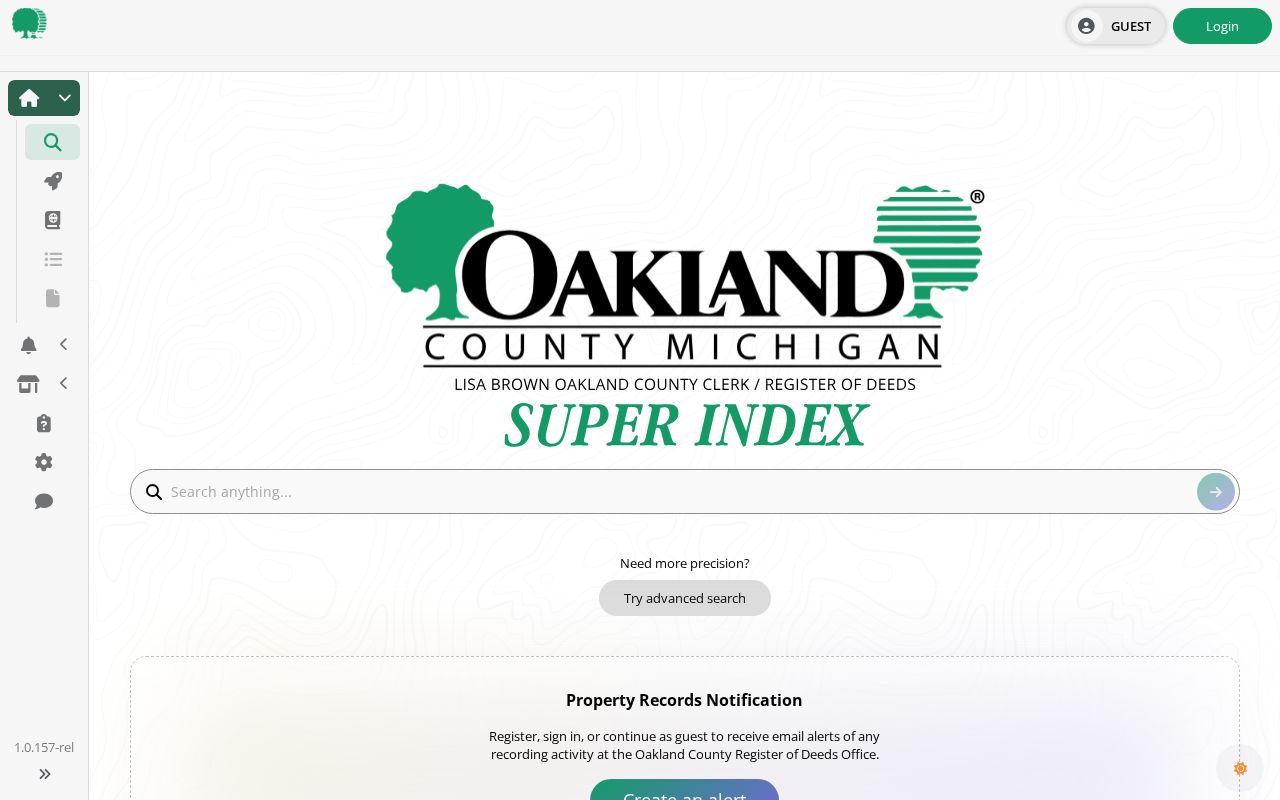
The interface converts parcel, owner, and date clues into recording references. Those references then carry a deed search backward through time.
Follow Oakland's Grantor-Grantee Trail
Each deed names two roles. The grantee received the interest. The grantor transferred it. Start with the newest plausible acquisition deed, then treat its grantor as the next historical search subject. Match the parcel and legal description at every handoff, because the same name can surface on unrelated Oakland County property records.
- Search the PIN and current roll name, then identify the latest deed naming that party as grantee.
- Copy the grantor, grantee, recording date, document number, liber/page, deed type, and legal description.
- Search that grantor as an earlier grantee, adding a date range and PIN to find the acquisition.
- Repeat until January 1964, then move to manual tract records and historic deed-book indexes.
- Grantor
- The party transferring the stated interest.
- Grantee
- The party receiving the stated interest.
- Chain of title
- The ordered series of instruments connecting interests in the same land.
- Liber/page and document number
- Two recording references used to retrieve and hand off between records.
January 1964 Divides Digital and Manual Research
The computerized Tract Index covers January 1964 to the present. Older deed records are not fully represented online. A "no result" there proves nothing. A pre-1964 transfer may still exist in the manual material, subdivision indexes, permanent plat files, or public binders the Tract Index maintains. Bring a Sidwell/PIN, party names, an approximate date, the subdivision, and the legal description. Take them to the counter. On July 1, 2026, Oakland County folded Acreage Book Search into the Super Index. The search remains free. Older instructions pointing to a separate acreage page are stale. Acreage and metes-and-bounds chains still demand close comparison of township, range, section, and description. Note: Staff can guide tract research by parcel ID. They will not read a long legal description over the telephone.
Plats Supply the Lot-and-Block Bridge
Platted land has its own bridge. Search county records with Record Type "PLAT Records," the county, and the subdivision name. Open the PLATS record, choose Record Info and Attachments, and pull the .tif image. The plat can show the original lots, blocks, roads, dedications, and easements. All of it was drawn on that instrument.
Remember that a plat is not the later ownership history. A deed may convey part of a lot. It may convey a condominium unit or an outlot. It may also convey land touched by a correction or a vacated right-of-way. Compare each deed's legal description against the plat label. Copies are listed at $2.50 per plat page, subject to current confirmation.
Historic Oakland Deed Books Extend the Record
The FamilySearch Oakland land catalog lists deed books for 1801–1901 and general indexes for 1799–1920. Those index volumes span narrower bands, including 1800–1869 and 1869–1888, with later volumes through 1920. Access may require an account or a FamilySearch Center. The Archives of Michigan county guide adds several record types. These include assessment rolls, tax rolls, probate files, and local township series. Early Oakland territory later became other counties. A nineteenth-century description may therefore require the historic jurisdiction. That jurisdiction is defined by its township, range, and section rather than a modern street address. Libraries and newspapers can point toward a person or an old place name. But the deed book and legal description carry the ownership evidence.
Property Records Notification Watches New Filings
Owners who have verified a deed can enroll in the county's free Property Records Notification service. Alerts can track names, addresses, document types, or PIN. The county guide recommends a precise ten-digit PIN. The service watches a database exceeding 13 million documents. An alert only reports a database change. It does not decide fraud occurred or correct an instrument, and broad name subscriptions can generate unrelated notices. Review the deed record itself, and contact law enforcement if a suspicious recording warrants a police report.
Obtain an Oakland County Deed Copy
Buying a deed image online works through the Super Index cart. The order information arrives by email, and you retrieve the image from there. An image may be inaccessible. Or you may already know the document number. In either case, contact the Clerk/Register of Deeds Real Estate or Micrographics unit. The counter sits at 1200 N Telegraph Road, Building 12E, Pontiac. It is open Monday through Friday from 8:30 a.m. to 4:30 p.m. Call 248-858-0597 for Real Estate or 248-858-0596 for the Tract Index.
Short orders are handled at the counter or by phone. Bigger requests go to Micrographics instead. County materials list ordinary copies at $1 per page, with certification adding $5 per document. Research-copy orders typically take 24 to 48 hours for pickup or mail. That timeline is separate from the longer turnaround for newly submitted recordings. Confirm pricing and timing before you order.
A mail request should identify the exact instrument. Bring the PIN, street address, legal description, parties, approximate date, and any known document or liber/page reference if visiting in person. Electronic submission and the title-company drop serve recording, not research copies.
Walk-in researchers may get courtesy images for short documents. Larger sets are routed to Micrographics. A certified copy authenticates the county copy as an official record. Certification does not turn the document into a title opinion. It also does not settle the legal effect of its language.
Recorded, not guaranteed. Oakland County deed records show what entered the recording system, not a title opinion; unrecorded interests and unresolved exceptions may remain.
For parcel mechanics, addresses, and assessor details, start with the Oakland County property search. A full ownership opinion still requires qualified title work beyond any index lookup.